Mexico suspended tariff increase on 1371 Chinese products

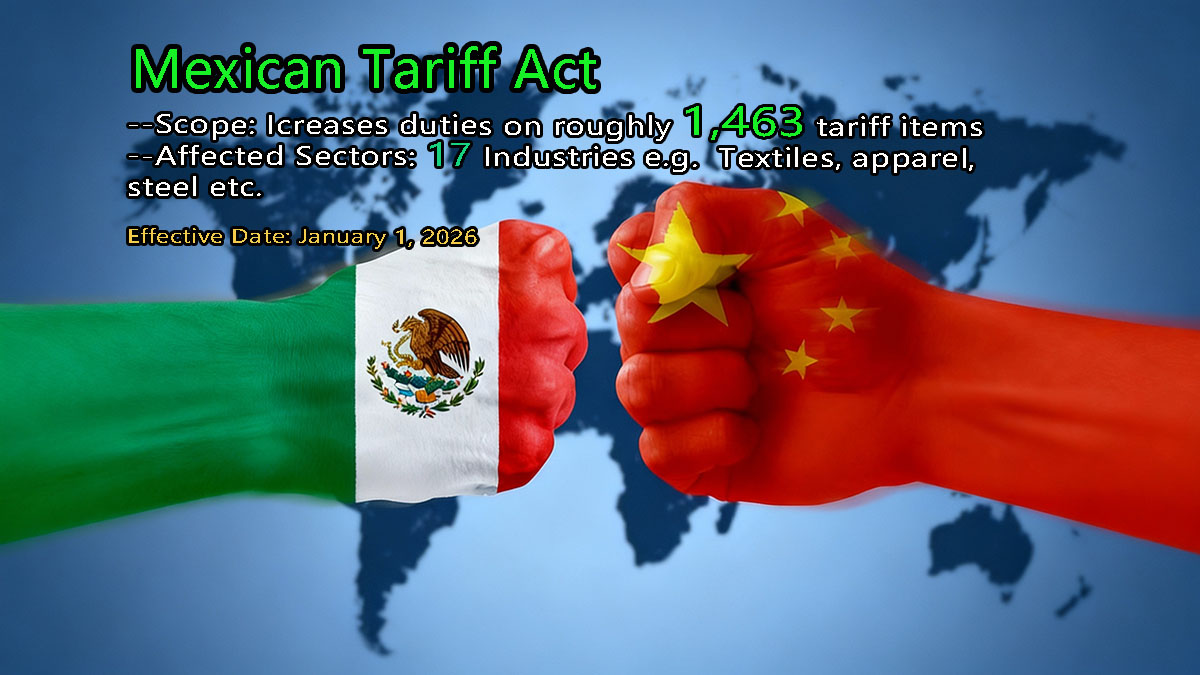
On October 9, 2025, Mexican President Claudia Seinbaum officially announced at her daily press conference that the Mexican Congress would temporarily suspend approval of the government's proposed tariff increase on 1,371 products from China and other Asian countries, and planned to hold consultations with China and other countries. Ricardo Monreal, leader of Mexico's ruling Morena Party in the lower house, later confirmed to reporters that Congress would "pause" its deliberations on the proposal and resume discussions at the end of November. This is a positive signal for many related industries.
Review on the Event
On September 10, 2025, Mexican President Claudia Seinbaum unveiled tariff reform proposals as part of her "Plan Mexico" industrial policy. These tariff adjustments target countries without free trade agreements with Mexico, with a particular focus on China and other Asian exporters. These tariff adjustments cover products under 1,371 tariff codes, including automobiles, auto parts, steel, textiles, and toys, representing 16.8% of all Mexican tariff codes. These products represent approximately $52 billion in imported goods, or 8.6% of Mexico's total imports.
Affected Industries/Product Categories
| Industry/Product Category | Originally Proposed Tariff Rate | Impact Analysis |
|---|---|---|
| Automobiles and Parts Light Vehicles | 50% Parts: 10%-50% | This is the core area of this tariff war. The suspension of tariff increases prevents a significant increase in the immediate cost of Chinese electric vehicle and parts exports to Mexico |
| Textiles and Apparel | 10%-50% | China is a major textile exporter, and maintaining the current tariffs will help safeguard the export competitiveness of Chinese textile and apparel companies |
| Steel Products | 35% | The suspension of high tariffs preserves a significant export market for Chinese steel products and stabilizes order expectations for related companies |
| Aluminum Products | 10%-50% | As a basic industrial material, the risk of trade barriers facing aluminum exports has been temporarily alleviated |
| Toys | 35% | Mexico is a key export market for Chinese toys, and maintaining the current tariffs will help ensure stable export orders during the holiday season |
| Footwear and Leather Goods | 10%-50% | Mexico has already imposed countervailing duties on some Chinese footwear, and the suspension of new tariffs avoids a further hit |
| Plastic products | No specific tax rate specified | Among the affected categories, allowing the plastics industry to avoid new export costs |
| Home appliances | No specific tax rate specified | Included in this temporary tariff deferral, benefiting related export companies. |
Background and Underlying Reasons
Mexico's "pause button" is the result of a multi-faceted negotiation and trade-off:
China's firm countermeasures: After Mexico announced its proposal, China's Ministry of Commerce announced on September 25, 2025, that it would initiate a trade and investment barrier investigation into Mexico's relevant measures in accordance with domestic law. This clearly demonstrated to Mexico that unilateral restrictive measures would undermine its own business environment and investment attractiveness.
Mexico's independent weighing: Mexican President Seinbaum stated that "consultations" with China and others are necessary before moving forward with legislation. This demonstrates that Mexico recognizes that maintaining a healthy economic and trade relationship with China within the global supply chain is in its own development interests and should not be solely influenced by third-party pressure.
Background of US Pressure: Public opinion generally believes that Mexico's initial proposal was linked to US pressure, hoping to gain more leverage in the United States-Mexico-Canada Agreement (USMCA), which is due for review in 2026.
Opportunities and Strategic Outlook for Businesses
The temporary reprieve from tariff threats has created a valuable window of opportunity for relevant companies. Chinese exporters can consider developing appropriate strategies to seize this opportunity.
Short-term Benefits for Exports: For the products listed in the table above, direct exports from China to Mexico have restored certainty in the short term. You can seize this opportunity to consolidate and expand your market share in Mexico.
Medium- to Long-Term Localization: This incident demonstrates that localizing production in Mexico or North America is a fundamental strategy for mitigating trade risks. For example, many Chinese auto parts companies (such as Tuopu Group) have already established factories in Mexico, not only avoiding high tariffs but also leveraging the preferential terms of the USMCA to enter the large North American market.
Focus on the New Energy Sector: The Mexican government is vigorously promoting the transition to new energy. China has global advantages in photovoltaic components, energy storage batteries and other fields. Although Mexico has localization requirements, this also means opportunities to invest and build factories locally.
Mexico Logistics Hot Events in October and Their Impact Analysis
Why did Mexico raise the tariffs on automobiles from China and other Asian countries to 50%
Related blog