The Mexican Senate approved amendments to the Law on General Import and Export Duties introducing substantial tariff increases on 1,463 tariff lines
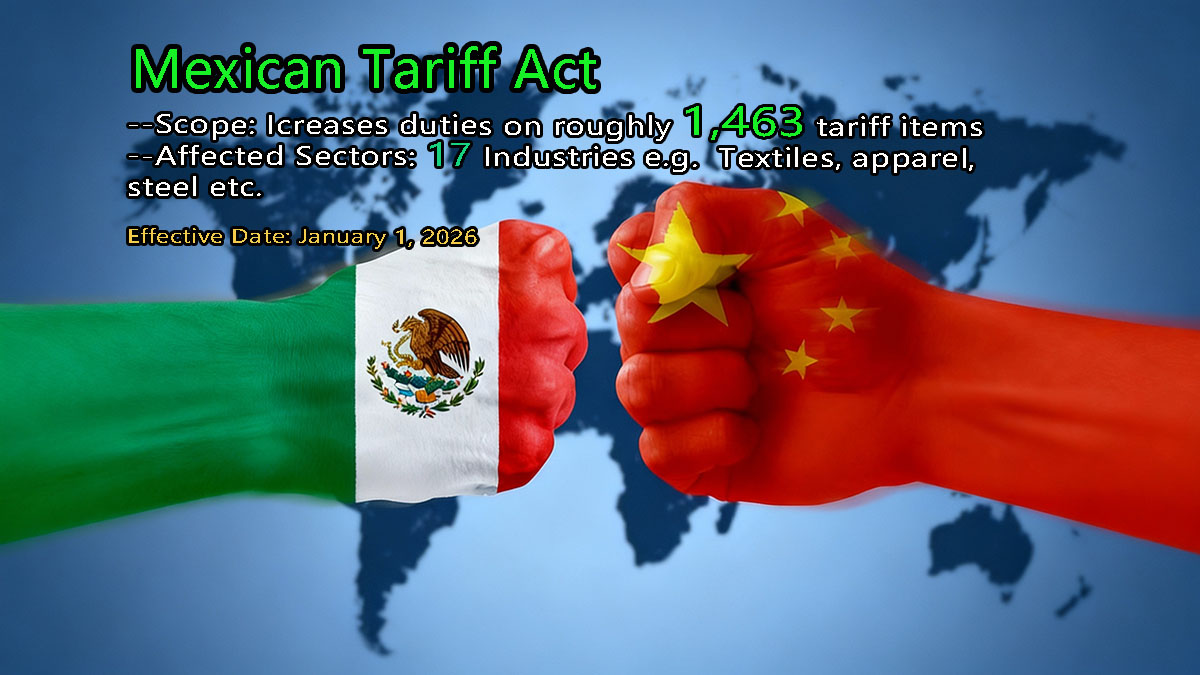
Recently, Mexico's Congress passed a tariff bill with far-reaching implications. Under the bill, starting January 1, 2026, Mexico will raise import tariffs on certain goods originating from countries without a free trade agreement (FTA) with Mexico. The new tariff rates will range from 10% to 50%, and China is among the affected countries.
As soon as the news broke, exporters operating in Latin America quickly began to feel the pressure.
I. How Broad Is the Scope of This Tariff Increase?
Based on currently disclosed information, this is far from a “symbolic adjustment.” The bill covers more than 1,400 HS codes, spanning around 17 industries.
Goods that previously carried tariff rates of 0–20% will now generally fall into a 10–50% range. Specifically:
* More than 300 HS codes that were previously duty-free will be taxed for the first time
* Around 340 HS codes will see tariffs raised directly to 35%
* Some products will face tariffs as high as 50%
During the legislative review process, the committee made multiple revisions to the original proposal. Tariffs for certain categories were lowered, and over 300 products were ultimately exempted. However, the overall policy direction remains unchanged.
II. Which Industries Will Be Hit First?
Foreign trade professionals should pay close attention to the following categories. According to the published list, the industries most affected are those that Mexico relies heavily on imports for and that are closely linked to Chinese supply chains, including but not limited to:
* Textiles & apparel: 1,014 HS codes | 10%–35%
* Steel & steel products: 249 HS codes | 15%–50%
* Automobiles & auto parts: 235 HS codes | 20%–50%
* Plastic products: 81 HS codes | 10%–35%
* Home appliances: 18 HS codes | 15%–30%
* Toys: 37 HS codes | 10%–25%
* Furniture: 28 HS codes | 15%–35%
* Footwear & leather goods: 67 HS codes | 10%–30%
* Paper & paperboard: 47 HS codes | 10%–20%
* Motorcycles: 8 HS codes | 20%–40%
* Aluminum products: 21 HS codes | 15%–35%
* Cosmetics & soap: 24 HS codes | 10%–25%
For Chinese exporters, the impact will be especially concentrated in auto parts, steel, textiles and apparel, and plastic products. Overall, the closer a product is to the core of the manufacturing value chain, the steeper the tariff increase tends to be.
III. Who Is This Targeting — and Why Is Mexico Taking Action?
This tariff hike is not a blanket measure, but one that clearly differentiates between trading partners. The higher tariffs apply mainly to countries without FTAs with Mexico, including:
China, South Korea, India, Thailand, Indonesia, Russia, Turkey, Brazil, the UAE, and South Africa, among others.
The United States, Canada, and the European Union are excluded, as they already have free trade agreements with Mexico.
The official rationale is straightforward: to protect domestic industries and reduce reliance on imports. Mexico's Ministry of Finance estimates that the new tariffs could generate over 50 billion pesos in additional revenue in 2026, while also giving local manufacturers more room to survive.
That said, the bill has not been without controversy domestically. Lobbying from Asian countries, along with opposition from some Mexican businesses and lawmakers, slowed the legislative process. This explains why the final version differs significantly from the original draft submitted in September.
IV. What Does This Mean for China–Mexico Trade?
In terms of scale, trade between China and Mexico is substantial. In 2024, bilateral trade exceeded USD 100 billion, with Chinese exports playing a dominant role.
China is also Mexico’s second-largest source of imports, accounting for approximately 19.96% of Mexico's total imports. Against this backdrop, the tariff hikes are likely to result in:
* A significant increase in export costs
* A clear decline in price competitiveness
* Further compression of profit margins for exporters
Key export categories such as electronic components, kitchenware, and motor vehicle parts are all included in the adjustment.
Despite strong government support for the policy, opposition remains within Mexico. Several local economic media outlets have pointed out that over 70% of Mexico’s imports consist of intermediate goods and production inputs. Raising tariffs may therefore hurt domestic supply chains first, rather than foreign exporters.
The Collapse of Mexican Freight Forwarder "Americ Star" and Its Causes
Related blog