Impact of the U.S. 25% Tariff Hike on Mexico's Economy and Logistics Landscape: Opportunities and Challenges for China-Mexico Supply Chains

On March 4, 2025, the United States officially imposed a 25% tariff on Mexican goods exported to the U.S., akin to a boulder dropped into water, causing significant ripples in Mexico's economy and international logistics. As a critical hub of the North American supply chain, Mexico's economic structure is heavily reliant on trade with the United States (accounting for over 80% of its total exports). The implementation of tariffs has not only increased corporate costs but also compelled Mexico to expedite the adjustment of its global trade strategy. In this context, the value of the China-Mexico logistics channel becomes increasingly prominent, presenting both challenges and new opportunities.
I. The Economic and Supply Chain Challenges Facing Mexico
1. Blockage of Exports to the U.S. and Soaring Corporate Costs
Mexico's core industries, such as automobiles, electronics, and agricultural products, have long depended on the U.S. market. The 25% tariff directly reduces the price competitiveness of export goods and squeezes corporate profit margins. U.S. retailers like Target and Best Buy have warned of rising commodity prices, which could dampen consumer demand and further exacerbate inventory pressure on Mexican exporters.
Mexico's core industries, such as automobiles, electronics, and agricultural products, have long depended on the U.S. market. The 25% tariff directly reduces the price competitiveness of export goods and squeezes corporate profit margins. U.S. retailers like Target and Best Buy have warned of rising commodity prices, which could dampen consumer demand and further exacerbate inventory pressure on Mexican exporters.
2. Acceleration of Supply Chain Restructuring
The U.S. tax increase policy has disrupted the integrated industrial chain of North America. For instance, in the automotive sector, Mexico's parts exports account for more than 30% of U.S. imports. Tariffs will compel automakers to reassess their production layouts, potentially shifting capacity to Southeast Asia or back to the U.S. In the short term, rising logistics costs and extended lead times will pose common challenges for Mexican companies.
The U.S. tax increase policy has disrupted the integrated industrial chain of North America. For instance, in the automotive sector, Mexico's parts exports account for more than 30% of U.S. imports. Tariffs will compel automakers to reassess their production layouts, potentially shifting capacity to Southeast Asia or back to the U.S. In the short term, rising logistics costs and extended lead times will pose common challenges for Mexican companies.
3. Economic Growth Pressure and Inflation Risk
According to Mexico's National Geographic Statistics Bureau, if the U.S.-Mexico tariff war persists, Mexico's GDP may decline by over 3 percentage points. Simultaneously, imported inflationary pressures may be transmitted to the Mexican domestic market through energy, raw materials, and other channels, further weakening consumer purchasing power.
According to Mexico's National Geographic Statistics Bureau, if the U.S.-Mexico tariff war persists, Mexico's GDP may decline by over 3 percentage points. Simultaneously, imported inflationary pressures may be transmitted to the Mexican domestic market through energy, raw materials, and other channels, further weakening consumer purchasing power.
II. The "Butterfly Effect" on International Logistics Patterns
1. Blockage of Traditional Logistics Routes
Traditional land transportation methods for Mexican exports to the U.S., such as rail and truck, face rising costs and fluctuating volumes. For example, trucking costs at the U.S.-Mexico border logistics hub are expected to rise by 15% to 20%. Some shippers may shift to sea freight to balance costs, but this increases the risk of congestion on trans-Pacific routes.
Traditional land transportation methods for Mexican exports to the U.S., such as rail and truck, face rising costs and fluctuating volumes. For example, trucking costs at the U.S.-Mexico border logistics hub are expected to rise by 15% to 20%. Some shippers may shift to sea freight to balance costs, but this increases the risk of congestion on trans-Pacific routes.
2. Opportunities in the "Two-Way Flow" of the China-Mexico Logistics Channel
a) Potential Growth in China's Exports to Mexico: To reduce dependence on the U.S., Mexico is actively diversifying its import sources. Chinese machinery and equipment, new energy products, and electronic products are expected to fill gaps in Mexico's local industrial chain. For instance, Mexico's planned green energy transition could significantly boost demand for Chinese photovoltaic modules and energy storage equipment, driving the expansion of China-Mexico maritime lines and cross-border land transport.
a) Potential Growth in China's Exports to Mexico: To reduce dependence on the U.S., Mexico is actively diversifying its import sources. Chinese machinery and equipment, new energy products, and electronic products are expected to fill gaps in Mexico's local industrial chain. For instance, Mexico's planned green energy transition could significantly boost demand for Chinese photovoltaic modules and energy storage equipment, driving the expansion of China-Mexico maritime lines and cross-border land transport.
b) New Challenges in Re-Export Trade: The U.S. has previously pressured Mexico to increase taxes on Chinese goods. However, if future policies change, Chinese goods transiting through Mexico to the U.S. may face more complex compliance reviews. Logistics enterprises must strengthen customs risk management and explore strategies such as "localized production in Mexico + export to the U.S."
3. Need for Logistics Infrastructure Upgrades
Mexico plans to construct new ports and expand storage centers to enhance logistics efficiency. For example, the port of Manzanillo is improving its handling capacity and may become a key node in China-Mexico shipping in the future. Chinese logistics enterprises can participate in investing in smart ports, bonded warehouses, and other projects to build a cross-border logistics network connecting "China - Mexico - Latin America."
Mexico plans to construct new ports and expand storage centers to enhance logistics efficiency. For example, the port of Manzanillo is improving its handling capacity and may become a key node in China-Mexico shipping in the future. Chinese logistics enterprises can participate in investing in smart ports, bonded warehouses, and other projects to build a cross-border logistics network connecting "China - Mexico - Latin America."
III. Coping Strategies for China-Mexico Logistics Enterprises
1. Flexible Adjustment of Transport Schemes
a) while leveraging Mexico's Free Trade Zone policies for temporary warehousing and processing to mitigate tariff impacts.
a) while leveraging Mexico's Free Trade Zone policies for temporary warehousing and processing to mitigate tariff impacts.
b) Extension of the China-Europe Express: Explore trans-Atlantic multimodal transport connecting Europe and Mexico via the China-Europe Express to diversify risks in the North American market.
2. Deepening Localization Services
Establish regional distribution centers in Mexico to provide integrated customs clearance, tax, and terminal distribution services. For example, aligning with the trend of "nearshore outsourcing" in Mexico, offer JIT (just-in-time) supply chain support for electronics and automotive companies.
Establish regional distribution centers in Mexico to provide integrated customs clearance, tax, and terminal distribution services. For example, aligning with the trend of "nearshore outsourcing" in Mexico, offer JIT (just-in-time) supply chain support for electronics and automotive companies.
3. Digital and Green Logistics Enablement
Introduce blockchain technology to trace the origin of goods, addressing potential increases in "origin review" requirements by the U.S. Additionally, promote electric trucks and low-carbon ships to align with Mexico's sustainable development goals and enhance the ESG competitiveness of enterprises.
Introduce blockchain technology to trace the origin of goods, addressing potential increases in "origin review" requirements by the U.S. Additionally, promote electric trucks and low-carbon ships to align with Mexico's sustainable development goals and enhance the ESG competitiveness of enterprises.
Conclusion: Navigating Crisis Toward New Opportunities
The tariffs imposed by the U.S. have had a short-term impact on Mexico's economy but have also accelerated the process of "de-Americanization." For China's logistics industry, this represents both a challenge—navigating a more complex international trade environment—and an opportunity to open new growth poles by deepening China-Mexico cooperation. In the future, those who can lead in establishing an efficient and resilient China-Mexico supply chain will seize opportunities amidst changing circumstances.
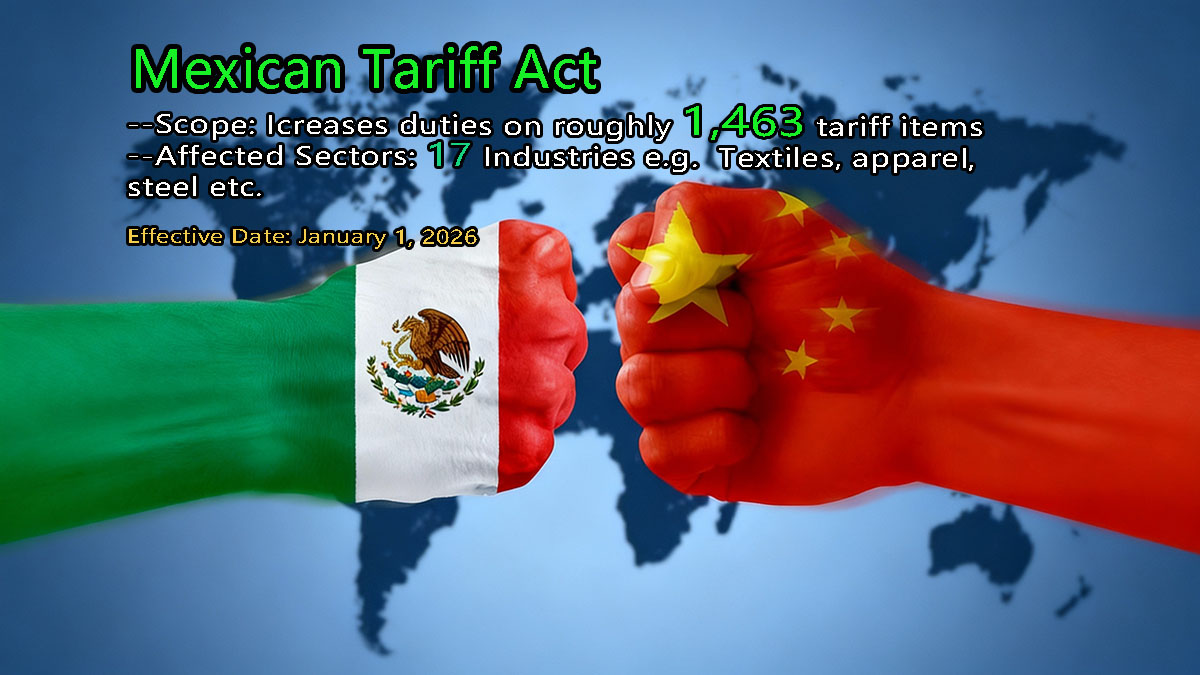
Mexico reviews tariffs on products from China
Related blog